

How to Check If Your Home Has a Water Leak Using Your Pretoria Meter
Water leak detection Pretoria 2026 starts with a test any homeowner can run in fifteen minutes without tools, without a plumber, and without spending a single rand. If your Tshwane water bill has spiked without explanation, if you hear running water when everything is switched off, or if a damp patch appeared on a wall that has no obvious cause, the water meter test tells you definitively whether water is moving through your property when it should not be.
This guide walks you through the exact test, shows you how to read a Tshwane water meter correctly, and explains what each result means for your next step.
Water Leak Detection Pretoria: Why Your Bill Might Be the First Warning
The City of Tshwane bills on a tiered consumption structure. Small increases in monthly usage can push you into a higher tariff bracket, which means the rand cost jumps more than the volume increase suggests. A leak of just 50 litres per day adds approximately 1,500 litres to your monthly reading. At 2026 Tshwane tariff rates, that adds R150 to R300 to your monthly bill depending on your current consumption bracket.
Most hidden leaks in Pretoria properties sit underground in the supply line between the meter and the house, under concrete slab floors in older Pretoria East and Pretoria West properties, or in toilet cisterns where the fill valve fails silently. None of these are visible from the surface. All of them register on your meter.
The City of Tshwane owns the pipe from the street to the meter. You own everything from the meter into the property. If the leak is on your side, the cost of wasted water is yours. If it is on the municipal side, report it to Tshwane directly and you cannot be billed for the loss.
How to Run the Tshwane Water Meter Test
This is the same test recommended by the City of Tshwane on their official leak detection guidance. It takes fifteen minutes and requires nothing except a notepad.
Step 1: Close every water source on your property
This means all taps, both indoor and outdoor. Switch off the dishwasher and washing machine. Make sure the geyser is not in a fill cycle. If you have an irrigation timer or garden soaker, disable it for the duration of the test. Every outlet that could draw water must be off.
Step 2: Locate your Tshwane water meter
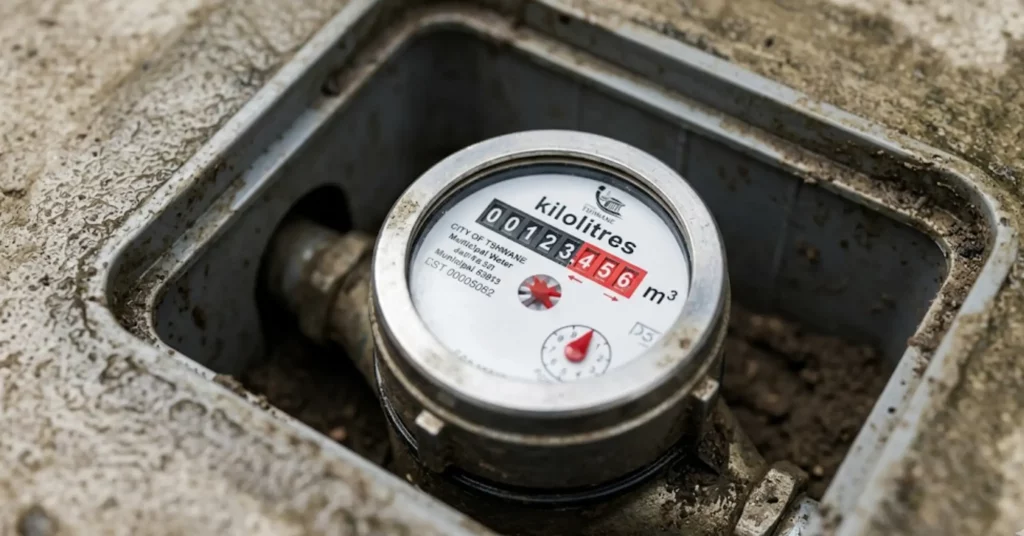
Your meter sits in a small box set into the pavement, ground, or boundary area near the front of the property. Lift the lid. You will see a row of black digits and a row of smaller red digits. The black digits measure kilolitres consumed. The red digits and the small rotating dial or sweep hand next to them measure litres.
Step 3: Photograph or write down the exact reading
Include the red digits. Some Tshwane meters also have a small triangular low-flow indicator that rotates continuously when even tiny amounts of water are moving. If that triangle is spinning before your 15-minute wait begins, you almost certainly have a leak.
Step 4: Wait fifteen minutes and check again
Do not use any water during this window. After fifteen minutes, recheck the meter. If the red digits have moved or the reading has changed, water moved through the meter with everything closed. That is a confirmed leak.
A toilet running silently is the most common cause of a positive meter test. Before calling a plumber, add a few drops of food colouring to the toilet cistern. Wait ten minutes without flushing. If colour appears in the bowl, the flapper valve is leaking and needs replacement. This is a low-cost fix.
What Your Meter Test Result Means
Five symptoms and what each one tells you, ranked from easiest to hardest to resolve:
Triangle spinning before the test starts
Likely cause: Active flow even before the test begins. The leak is running continuously.
Action: Check toilets with the food colouring test immediately. If clean, the leak is likely in a supply pipe.
Digits move within 5 minutes
Likely cause: A significant leak of 100 litres or more per day.
Action: Stop using water entirely and call a leak detection specialist. The volume is large enough to cause structural damage.
Digits move slightly after 15 minutes
Likely cause: A moderate leak, 20 to 80 litres per day.
Action: Check toilet cisterns and exposed tap connections. If nothing is found, acoustic leak detection is required.
No movement, but bill is still high
Likely cause: Either an estimated billing period, a recent one-off large use, or an intermittent leak.
Action: Compare this month’s reading with last month. Track readings monthly to identify patterns.
No movement, no unusual bill
Likely cause: No leak detected at this time.
Action: Run this test every six months as a routine check. It takes fifteen minutes and catches problems early.
Meter Test Positive? We Locate the Source Without Breaking Walls
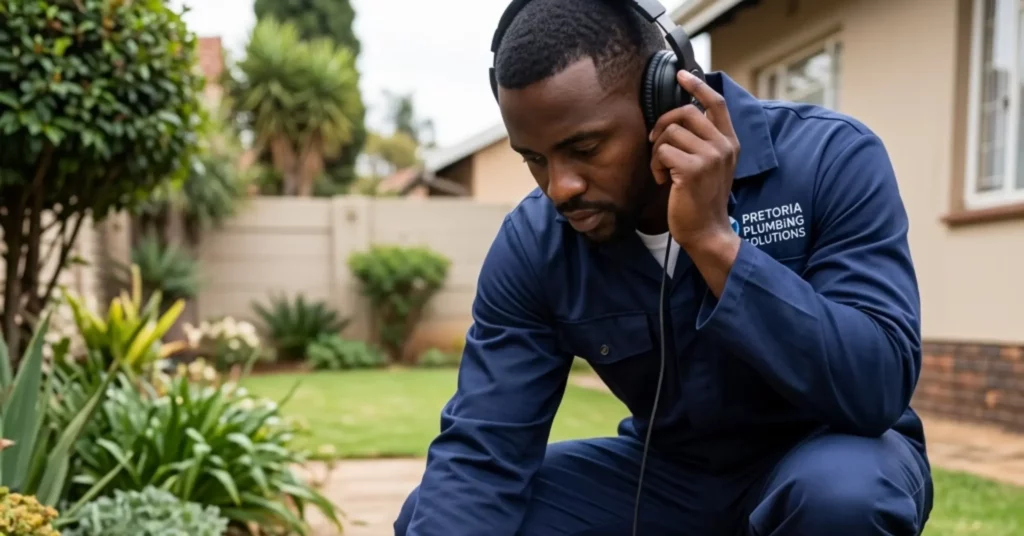
Our leak detection team uses acoustic, thermal, and tracer gas equipment to pinpoint underground and in-slab leaks across Pretoria.
What Happens After a Positive Meter Test
A positive meter test confirms water is moving. It does not tell you where. The next step depends on what you find when you check manually.
- Running toilet: Replace the flapper valve or fill valve. This is the most common cause of a positive meter test and costs R500 to R900 to fix. Our tap and fixture repair team can carry this out same day across Pretoria.
- Dripping tap: Visible drip means the washer or cartridge has failed. A 10-drip-per-minute tap loses around 15 litres per day. Not catastrophic but worth fixing promptly.
- No visible source found: The leak is underground, under the slab, or inside a wall. This is where professional acoustic or thermal detection becomes necessary.
Underground supply line leaks are more common in Pretoria East suburbs where original copper pipes from the 1980s and 1990s are reaching end of service life. Our leak detection team in Pretoria uses non-invasive equipment to mark the exact point of failure before any excavation begins, saving significant cost on unnecessary digging.
What Does Professional Leak Detection Cost in Pretoria in 2026
Professional water leak detection in Pretoria using acoustic, thermal, or tracer gas methods ranges from R1,200 to R3,000 depending on the method required and the complexity of the property. Detection and repair are always quoted separately. The detection fee covers locating and marking the leak only. Repair is then quoted based on what needs to be accessed.
A water meter check is always included at no charge during a detection callout. Full pricing for all leak detection methods is available on our Pretoria plumbing prices page so you can budget accurately before booking.
If your Tshwane bill has spiked and you need a second opinion on whether the reading is accurate, you can submit a meter reading dispute to the City of Tshwane directly. If the dispute confirms a faulty meter, you are not liable for the excess consumption. Our team has assisted Pretoria North and Centurion property owners with leak reports and dispute documentation on multiple occasions.
High Tshwane Water Bill in 2026? Start with the Free Meter Test
Run the 15-minute test above. If it is positive, contact us and we will locate the source using non-invasive equipment before any work begins.
Frequently Asked Questions
Can I dispute a high Tshwane water bill if a leak was found?
Yes. If a plumber confirms a leak was present and provides a written report with the location and repair date, you can submit a dispute to Tshwane requesting a consumption credit for the billing periods affected. The City of Tshwane has a formal dispute process and a policy of reviewing cases where a confirmed leak accounts for unusual consumption. Keep all documentation including the plumber’s report and the repair invoice.
How do I know if the leak is my responsibility or Tshwane’s?
The City of Tshwane is responsible for the supply pipe from the street to your meter, and for the meter itself. You are responsible for all pipework from the meter into your property boundary. If the meter test is positive but a plumber cannot find a leak on your side, ask Tshwane to inspect the meter and supply pipe upstream. Do not attempt to open or adjust the meter yourself as this constitutes tampering under the Water Services Act.
How much water does a silent toilet leak waste per day?
A toilet with a failing flapper valve or fill valve can waste between 200 and 800 litres per day silently. At 2026 Tshwane tariffs, that represents R180 to R700 per month in wasted water depending on your consumption bracket. The food colouring test is the fastest way to confirm whether a toilet is the source.


