

What To Do When Your Geyser Bursts in Pretoria
Water pouring through your ceiling is one of the most stressful moments a Pretoria homeowner faces. Whether it happens on a Sunday morning or at two in the morning, the first few minutes matter more than anything else. The decisions you make immediately after a geyser bursts determine whether you are looking at a manageable repair or thousands of rands in ceiling, flooring, and property damage.
This guide walks you through exactly what to do, in order, so you can stop the damage before it spreads and understand what type of problem you are actually dealing with before you call anyone.
The First Three Minutes of Geyser Bursts Matter Most
When a geyser fails, water continues flowing into and out of the system until you intervene. Most Pretoria homes with a failed geyser can lose anywhere from 100 to 400 litres of water in the first twenty minutes if nothing is done. That water does not just drain away. It pools in your ceiling, soaks through plasterboard, damages cornices, runs down walls, and warps wooden floors below.
The two things that stop this from escalating are straightforward. You need to cut power to the geyser and you need to cut water supply to it. Neither requires tools. Neither requires a plumber. Both can be done in under three minutes if you know where to look.
Step One: Switch Off the Geyser at the DB Board
Your distribution board, the grey electrical panel usually found in a passage, garage, or utility area, will have a circuit breaker labelled GEYSER or HOT WATER. Flip it to the OFF position.
This step is more important than most homeowners realise. A geyser heating element is designed to operate submerged in water at all times. The moment water level drops below the element, it begins heating air instead of water. Within minutes the element overheats, burns out, and in some cases warps the thermostat housing or compromises the tank itself.
If your DB board is not labelled, switch off the main breaker entirely until a plumber can identify the correct circuit. Leaving a dry-running element powered is the single most expensive mistake made after a geyser failure in 2026.
If there is water near your electrical panel, do not approach it. Contact us first and we will guide you safely before anyone touches a switch.
Step Two: Close the Main Water Supply Valve
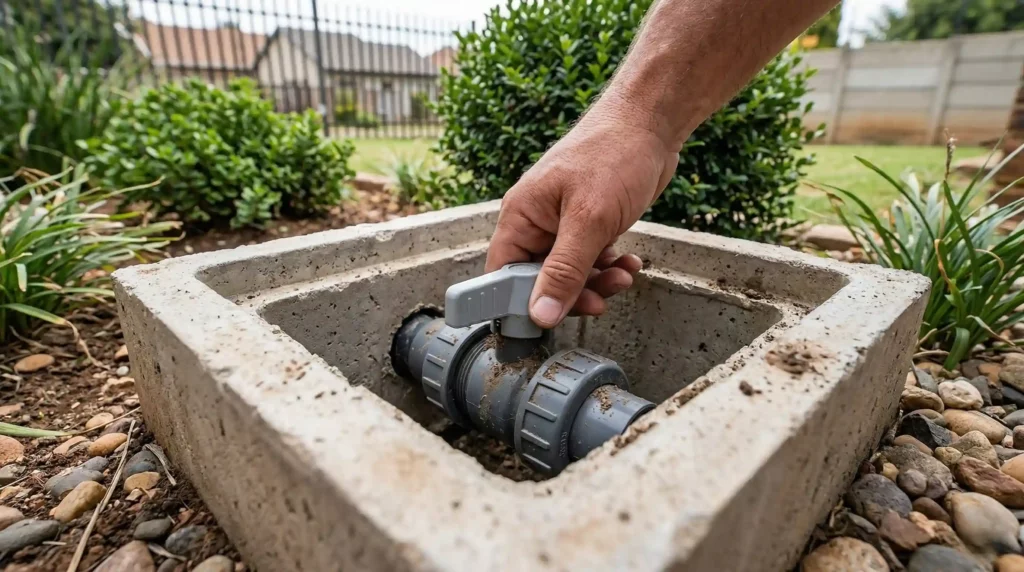
Your main water shutoff valve controls all water entering the property from the Tshwane municipal supply. Closing it stops water feeding into the geyser and halts the overflow.
Where to find your main valve in Pretoria properties
Location varies depending on the age and type of property. In most Pretoria homes built before 2000 it sits outside near the boundary wall close to the water meter. In newer estates and complexes it is often inside a utility cupboard or beneath the kitchen sink. Some older Pretoria North and Pretoria East properties have the valve in a shallow pit at the front of the garden.
Turn the valve clockwise until it stops moving. Once the main valve is closed, open a cold tap inside the house to release residual pressure in the pipes. You will hear water spitting as the pressure drops. This is normal and stops within thirty seconds.
Step Three: Work Out What Actually Happened
Not every water emergency means the geyser itself has failed. The repair cost, the urgency, and whether you need a full replacement depends on where the water is coming from. Before you call anyone, take two minutes to identify the source.
Water dripping or running from a small pipe through the eaves or ceiling
This is almost always the pressure relief valve (PRV) doing its job. The PRV is a safety device designed to discharge water when pressure inside the geyser exceeds safe limits. Occasional dripping is normal. Water running continuously indicates the PRV needs replacement. This is a component repair, not a full geyser replacement, and costs between R500 and R900.
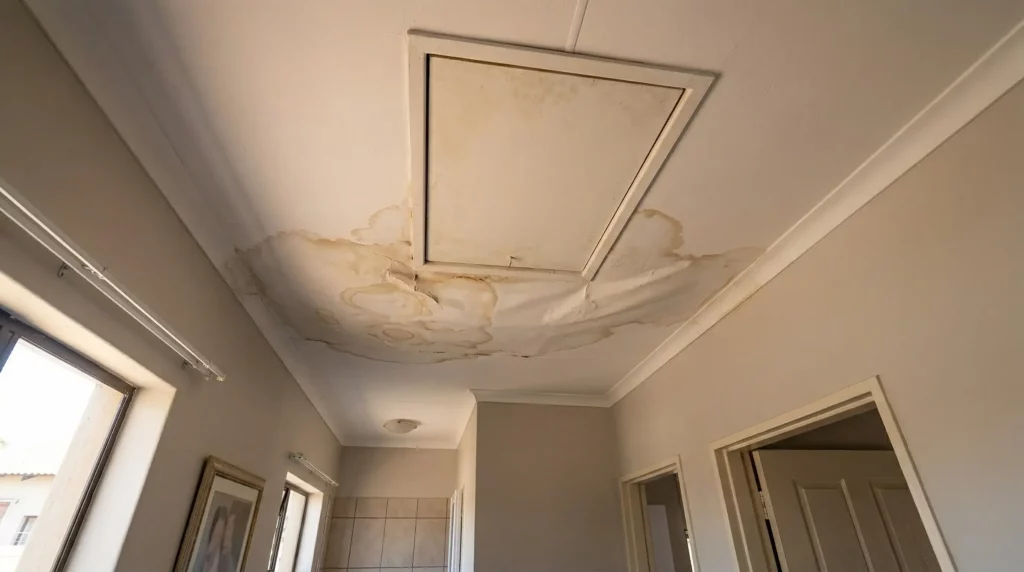
Water staining the ceiling boards, pooling in plasterboard, or soaking through
The geyser tank body has likely failed. This typically requires full replacement. You can check current geyser installation prices for Pretoria before you call so there are no surprises when a plumber arrives.
Water around a pipe joint, fitting, or connection rather than the tank
A valve, fitting, or pipe connection has failed. The tank itself is intact. This is the best-case scenario. Most fitting failures are repaired within a single visit and cost significantly less than a full replacement.
Not Sure What You Are Dealing With?
Send us a photo of the damage via WhatsApp or email and we will tell you immediately whether it is a repair or a replacement — before anyone drives out.
Step Four: Limit the Ceiling Damage While You Wait
If water is visibly pooling and bulging in a ceiling board, use a screwdriver or sharp implement to pierce the lowest point of the bulge. This sounds counterintuitive but it is the correct approach. A controlled hole allows the water to drain at one point rather than spreading across the full board until the entire section collapses under the weight.
Place buckets or large containers below the drip. Move electronics, rugs, wooden furniture, and anything valuable out of the affected area. Open windows in the affected room to begin the drying process. Trapped moisture accelerates mould growth, which compounds the repair cost significantly.
Photograph everything at this stage. Ceiling boards, the water pooling, the visible staining, and any property damage below. Your insurer will require documented evidence for a burst geyser claim under buildings cover.
Did This Happen After a Tshwane Water Outage
If your geyser failed within hours of Tshwane restoring water supply after a scheduled outage, the two events are almost certainly connected. This is one of the most common causes of geyser element failure across Pretoria in 2026.
When Tshwane cuts the municipal water supply, many households continue using their hot water for showers, cooking, and washing. The water level inside the geyser tank drops. If enough hot water is drawn and the geyser heating element is left on, the element eventually runs without water around it. It overheats. When supply resumes, cold water floods back into the hot, partially empty tank. The thermal shock cracks or burns out the element.
Protecting your geyser during Tshwane water shedding requires a specific protocol. A water backup system installed at your property removes the risk entirely by maintaining a constant water supply to the geyser regardless of what the municipality is doing.
Do You Need a Full Replacement or a Repair
The honest answer is that most burst geyser callouts in Pretoria in 2026 result in either a component repair or a full tank replacement. The deciding factor is the age of the unit and where the failure occurred.
A repair is usually the right call when
- The element, thermostat, or PRV has failed but the tank body is intact
- The geyser is less than eight years old
- There is no rust staining on the ceiling boards beneath the unit
- The failure was a fitting or valve, not the tank itself
A full replacement is usually the right call when
- The tank body has corroded or the outer casing is damaged
- The geyser is more than ten to twelve years old. Repair costs on an aging unit rarely justify the spend
- This is the second or third component failure within twelve months
- You want to switch to a solar geyser or heat pump as part of the replacement
Our geyser repairs and installation team in Pretoria will assess the unit on arrival and confirm whether repair or replacement makes more financial sense before any work begins. You always get a written quote first.
What Happens When the Plumber Arrives
A PIRB-registered plumber arriving at a burst geyser callout in Pretoria will follow a specific sequence before any work begins.
- Visual inspection of the geyser, all visible pipework, the overflow, and the ceiling condition below the unit
- Pressure test to determine whether the tank body is compromised or the failure is component-level
- Written quote issued before any work starts, with repair and replacement options shown separately if both apply
- Work completed: element replacement, PRV replacement, or full unit installation depending on the quote you accept
- Plumbing Compliance Certificate (COC) issued on completion of any new installation as required under SANS 10254
A plumber who starts work before issuing a written quote or who cannot provide a COC after a geyser installation is working outside the required standard. Always ask for both before work begins.
Areas We Cover for Burst Geyser Repairs in Pretoria
We respond to burst geyser callouts across greater Pretoria 24 hours a day. This includes Centurion, Pretoria North, Pretoria East and all surrounding suburbs. Emergency callouts after hours carry a higher rate. You can see our current after-hours call-out fees and geyser repair prices on our Pretoria plumbing prices page so you know the cost before you pick up the phone.
Burst Geyser in Pretoria? Get a Same-Day Response
WhatsApp us a photo of the damage. We confirm whether it is a repair or replacement, give you a price, and dispatch — before anyone arrives at your door.
Frequently Asked Questions
How much does a burst geyser repair cost in Pretoria in 2026?
Component repairs such as element or thermostat replacement range from R800 to R1,500 for parts and labour. A full 150L geyser replacement, supply and install including the COC, ranges from R7,500 to R10,500. Difficult ceiling access or after-hours callouts carry additional charges confirmed in writing before work starts.
Can I claim a burst geyser from my home insurance?
Most South African home insurance policies cover sudden and accidental geyser failure under the buildings section. Damage caused by lack of maintenance or wear and tear is typically excluded. Photograph everything before any repair begins and keep the COC from the replacement as proof of compliant installation for future claims.
How long does a geyser replacement take?
A standard ceiling-mounted 150L electric geyser replacement in a Pretoria home takes between three and five hours from arrival to sign-off, including the compliance inspection and COC issue.
My overflow pipe is dripping but not running. Is that normal?
Occasional dripping from the overflow pipe, particularly after a period of heavy hot water use when the geyser reheats, is normal. The PRV discharges small amounts of water as pressure builds during heating cycles. If the dripping is constant, the PRV is faulty and needs replacement. If water is running rather than dripping, switch off the geyser at the DB board and call a plumber.


